Published on December 5th 2025
Wondering how winter affects your Electric Vehicle?
As we move into the colder months, it’s important to know how the colder weather might impact your EV and what you can do to keep your vehicle performing through winter.
EV batteries perform less efficiently in winter as temperatures drop. This means that you’ll see a drop in your vehicle’s range. When you’re deciding on an EV, it can be helpful to know how much your EV’s range changes with the weather – for this, our leasing partners at DriveElectric have you covered.
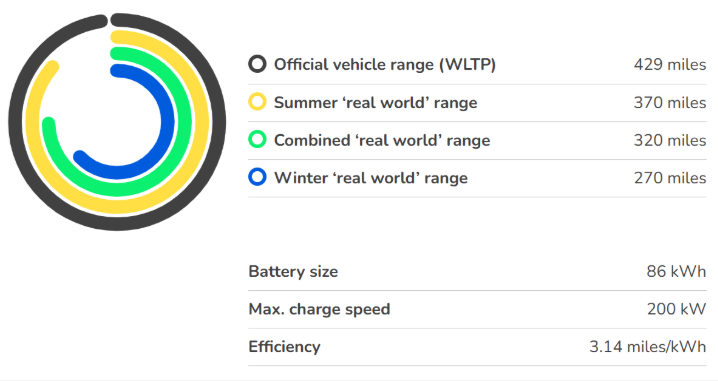
DriveElectric not only provides the Official Vehicle Range, but also gives a Summer ‘Real-world’ Range, Winter ‘Real-world’ Range, and Combined ‘Real-world’ Range. Knowing your vehicle’s real-world performance is key to negotiating longer journeys in the colder winter months.
Why do EVs have a smaller range in winter?
Electric Vehicle batteries perform less efficiently as the temperature drops because the chemical reaction within the battery that generates power slows down.
The way you use your car in colder weather might also have an impact on the vehicle’s range. Unlike conventional petrol or diesel engines, EVs generate far less waste heat – whilst this is beneficial as your car is performing more efficiently, it means that staying toasty in the car necessitates the use of power-intensive resistive heating.
Cold weather and charging
Charging speeds also slow down as temperatures drop, meaning it will take longer for your car to charge up. This is for the same reason that your EV’s range diminishes in winter – the chemical reactions within lithium-ion batteries happen more slowly at those lower temperatures. It’s important to consider how this might change your journey times if you’re travelling longer distances – especially if you’re travelling back from the mainland with a ferry to catch!
What can I do to improve the range of my EV in winter?
Heating your car
To avoid or reduce your use of that power-intensive resistive heating, manufacturers recommend using your car’s heated seats rather than blasting the cabin heaters. Heated seats are a more targeted and energy-efficient way of keeping you warm on your travels. If you use the heated seat you won’t need to use the heating as much.
Making the most of the tech that your EV offers can also help you reduce your use of the power-hungry heating. Some newer EVs have a heat pump which makes that heating process less power-intensive – this is not always included as a standard feature, so it’s useful to check the different spec levels of a vehicle you’re interested in before buying or leasing. Most EVs allow you to pre-condition the car cabin – some even have an app to let you control the pre-conditioning without having to leave your house. If you have a home-charger, using pre-conditioning whilst your car is still plugged in means that you won’t eat into the range. It also boosts your battery’s performance by heating it up before you set off!
Make the most of your EV’s tech
It’s well worth exploring the tech your car has to offer. Not only do many EVs, like the Peugeot e-208, have pre-conditioning remote control via mobile app, but most cars also have an ECO mode which adapts your EV’s performance to prioritise energy efficiency, primarily by altering throttle response to adapt for a smoother acceleration and deceleration. ECO mode also optimises your EV’s regenerative braking to most efficiently recapture its kinetic energy and put electricity back into the battery. Some models like the VW eUp! Have a heated windscreen – ideal for defogging and de-icing on cold mornings. It’s easy to find out what features your car has by visiting DriveElectric’s website and exploring the dropdown menus with information on performance, battery information, and equipment – including details of the interior and exterior features, safety measures, and driver convenience.
Topping up your charge
Keeping your car topped up, rather than having to charge from a low battery, allows some of the spare energy to be used to keep the battery warm enough to speed up the chemical reactions needed for charging – meaning your car charges faster. You can also plan to pre-condition your battery by coordinating your travel and charging; if you’ve driven shortly before charging, this will help your battery charge up more efficiently. A 30-minute journey before charging your car will heat the battery enough to allow it to charge it more quickly, and will help protect the battery’s lifespan, too.
Key Takeaways for EVs in Winter:
❄️ Colder temperatures mean the chemical reactions powering your EV’s battery happen more slowly, making your car’s battery and charging less efficient and lowering your range
❄️ Changes in the way you use your vehicle during winter, like more intensive use of the cabin heater or more frequent de-misting, will also reduce your EV’s range
⚡Use your car’s heated seats and heated windshield rather than heating the whole cabin – it's less energy intensive than the air heaters
⚡Pre-condition your car before you set off, whilst the vehicle is still plugged in, to avoid eating into your range – this will help keep you toasty, and heat up the battery to allow it to perform as efficiently as possible
⚡Don’t let your battery run too low before charging it – keeping the charge above 20% helps maintain the battery health and helps your car charge up more quickly
⚡Charge your car right after a journey, whilst the battery is still warm, to speed up the charge time